Moss Green Crochet Turtle | Flower on Shell | Handmade Cottagecore Plush
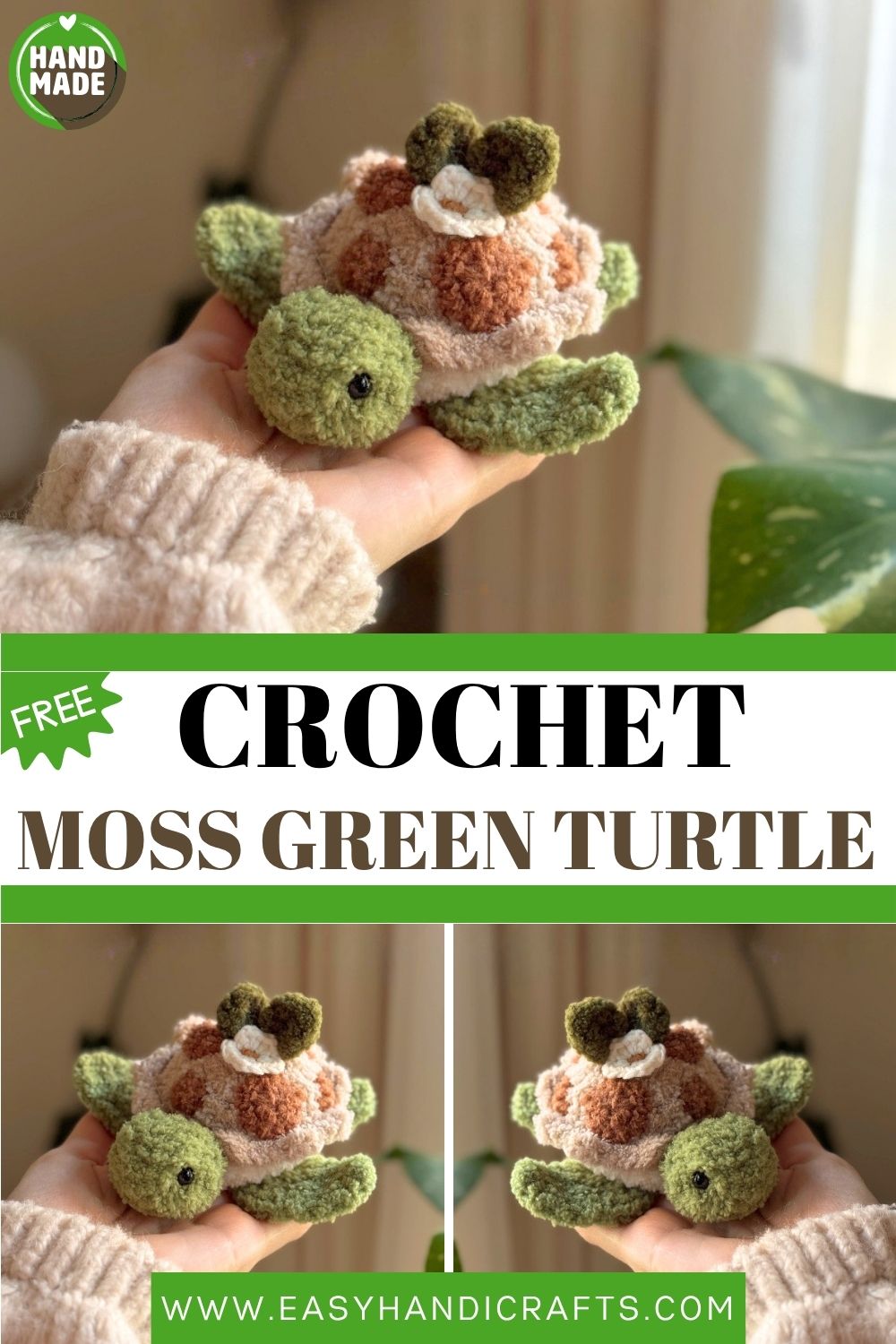
This mossy little turtle carries a flower garden right on its shell, the most enchanting cottagecore crochet plush you will ever make!
Some crochet projects feel like they belong in a fairy tale. This moss green turtle is one of them. It is soft, round, and decorated with hand-crocheted brown shell patches, a tiny yellow and white flower, and two little green leaves sitting right at the center of the shell. Furthermore, the shell and belly are worked as one connected piece using a clever front loop and back loop split technique. This gives the finished turtle a beautifully dimensional shell with a decorative scalloped edge that frames the belly perfectly. In addition, the head and four fins are all worked separately and then assembled with clean, precise placement that gives the finished turtle a natural, lifelike pose. The small flower and leaf details on top of the shell are the final touch that transforms this piece from a standard turtle amigurumi into something that feels genuinely cottagecore and special. Whether you display this turtle on a windowsill, gift it to a nature lover, or add it to a handmade woodland scene, this pattern delivers a finished result that is as charming to look at as it is satisfying to make.
Skill Level
Intermediate. Single crochet in continuous rounds forms the foundation. Additionally, front loop and back loop split construction, scalloped shell edging, and small detail assembly introduce satisfying new techniques throughout the pattern.
Materials You Will Need
Yarn:
- Green bulky yarn for the head and fins — Alize Softy No. 485
- Beige bulky yarn for the shell — Alize Softy No. 115
- Cream bulky yarn for the belly — Alize Softy No. 62
- Brown yarn for the shell pattern circles — Alize Softy No. 321
- Green yarn for the leaves — Alize Softy Plus No. 620
- Yellow and white yarn for the flower — Hobbii Cosy in Toffee and White
Other Supplies:
- Crochet hook — 4.5mm for body and shell
- Crochet hook — 3mm for flower, leaves, and shell pattern
- Safety eyes — 7mm
- Polyfill stuffing
- Stitch marker
- Scissors
- Sewing needle
Abbreviations
- MR — Magic Ring
- ST — Stitch
- SLT — Slip Stitch
- SC — Single Crochet
- INC — Increase (2 sc in 1 stitch)
- DEC — Decrease
- FO — Fasten Off
- DC — Double Crochet
- HDC — Half Double Crochet
- FLO — Front Loops Only
- BLO — Back Loops Only
- (#) — Number of stitches in round
- […] — All worked into one stitch
Note: This pattern works in continuous rounds. Place a stitch marker into the first stitch of each new round throughout the entire pattern.
Pattern: Head
Using green yarn and a 4.5mm hook
R1: 6 sc in MR (6) R2: 6 inc (12) R3: (sc, inc) x6 (18) R4–6: sc around for 3 rounds (18) R7: (sc, dec) x6 (12)
Add safety eyes between R3–4, approximately 7–8 stitches apart.
Stuff the head firmly at this point.
R8: 6 dec (6)
Fasten off. Do not close the hole. Leave a long tail for sewing. The open hole allows the head to be sewn flat and flush against the shell body.
Pattern: Front Fins Make 2
Using green yarn and a 4.5mm hook
R1: 6 sc in MR (6) R2: 6 inc (12) R3: (sc, inc) x6 (18) R4: (2sc, inc) x6 (24)
Do not stuff. Fold in half and close with 12 sc through both layers.
Fasten off and leave a long tail for sewing.
Pattern: Back Fins — Make 2
Using green yarn and a 4.5mm hook
R1: 6 sc in MR (6) R2: 6 inc (12) R3: (sc, inc) x6 (18)
Do not stuff. Fold in half and close with 9 sc through both layers.
Fasten off and leave a long tail for sewing.
Pattern: Shell and Belly
Using beige yarn and a 4.5mm hook
R1: 6 sc in MR (6) R2: 6 inc (12) R3: (sc, inc) x6 (18) R4: (2sc, inc) x6 (24) R5: (3sc, inc) x6 (30) R6: sc around (30) R7: (4sc, inc) x6 (36) R8: (5sc, inc) x6 (42)
Shell Edge
R9: FLO — (sc, [(hdc, dc, hdc) in one st], sc) x13, 3 slt (68)
This front loop round creates the decorative scalloped shell edge. Each bracket section forms one small petal-like point around the shell rim.
Switch to cream yarn for the belly. Fasten off and hide the shell yarn tail.
Belly
Continue by working only into the back loops of R9.
R9 BLO: sc around (42)
Begin stuffing the shell body now and continue adding stuffing gradually through each remaining round.
R10: (5sc, dec) x6 (36) R11: (4sc, dec) x6 (30) R12: (3sc, dec) x6 (24) R13: (2sc, dec) x6 (18) R14: 9 dec (9)
Fasten off and close the hole securely.
Assembly
Attaching the Head
Sew the open side of the head directly to the body. Position it exactly where the slip stitches of the shell edge sit. The head fits naturally into this gap. The highest point of the head should sit just below the slip stitch row. You can adjust the exact height slightly to suit your preference.
Attaching the Fins
Place the front fins with the rounded side facing forward toward the head. Position them 4 stitches apart from each other on the front sides of the body. Leave a 3-round gap between the shell edge and where each fin attaches.
Place the back fins on the back sides of the body. Position them 2 stitches apart and maintain the same 3-round gap from the shell edge as the front fins.
Pattern: Flower
Using yellow yarn and 3mm hook — Hobbii Cosy Toffee
R1: 5 sc in MR (5)
Switch to white yarn.
R2: (sc, dc, ch1, dc) x5 (15)
Slip stitch. Fasten off and leave a long tail for sewing. The white petal round fans naturally spread outward around the yellow center for a daisy-like flower shape.
Pattern: Small Leaf
Using green yarn and a 3mm hook, Alize Softy Plus No. 620
Chain 4. Starting from the second chain from the hook: sc, hdc, slt, ch1.
Work on the opposite side of the chain: slt, hdc, sc.
Fasten off and leave a tail for sewing.
Pattern: Big Leaf
Using green yarn and a 3mm hook
Chain 5. Starting from the second chain from the hook: 2sc, hdc, slt, ch1.
Work on the opposite side of the chain: slt, hdc, 2sc.
Fasten off and leave a tail for sewing.
Pattern: Shell Circles
Using brown yarn and a 3mm hook
Make the following separate circles and sew them onto the shell in any arrangement you like. Leave the center of the shell (R1–2) free for the flower and leaves.
- 2 circles: R1 — 6 sc in MR. Fasten off.
- 1 circle: R1 — 6 sc in MR. R2 — 6 in (12). Fasten off.
- 1 circle: R1 — 5 sc in MR. R2 — 5 inc (10). Fasten off.
- 1 circle: R1 — 5 sc in MR. Fasten off.
- 1 circle: R1 — 8 sc in MR. Fasten off.
Sew all circles across the shell surface in a natural, scattered arrangement. Then attach the leaves and flower at the very center of the shell on top.
Customization and Variation Ideas
- First, swap the green body for a soft sage or dusty teal for a more muted, earthy cottagecore palette that photographs beautifully in natural light.
- Additionally, try a lavender and cream color combination for the shell and belly. A purple turtle with a pink flower on its shell creates a dreamy, whimsical variation.
- Moreover, add extra leaves around the flower center for a fuller, more lush garden scene on top of the shell.
- Furthermore, skip the brown shell circles entirely and use surface slip stitches in a contrasting color to draw geometric patterns across the shell for a more graphic, modern look.
- Also, make a miniature version using fingering-weight yarn and a 2mm hook. A tiny turtle that fits on a fingertip makes an incredibly sweet keychain or bag charm.
- Finally, create a family set in three sizes using different yarn weights: a large mother turtle, a medium middle turtle, and a tiny baby. All three use the same pattern scaled at different gauges.
Common Mistakes to Avoid
- First, working R9 in both loops instead of splitting them: The entire shell and belly construction depends on correctly separating the front and back loops of R9. Working both loops at once removes the gap needed for the belly continuation.
- Additionally, stuffing the fins before folding: The fins must remain unstuffed. Stuffing them before folding creates a bulky, lumpy wing that cannot be folded and closed cleanly.
- Also, closing the head hole before sewing: The head is specifically left open after R8. Closing it creates a rounded base that cannot be sewn flush against the body at the shell gap position.
- Furthermore, sewing fins with the rounded side facing backward: The rounded side of every fin must face forward toward the head. Backward-facing fins create a stiff, unnatural look that disrupts the turtle’s silhouette.
- Moreover, placing the flower before the shell circles: Always sew the brown circles across the shell first and leave the center clear. The flower and leaves are always the last details added on top at the very center.
- Finally, using the 4.5mm hook for the flower and leaves: The smaller 3mm hook is essential for the detail pieces. Using the larger hook creates loose, oversized details that look out of proportion against the carefully worked shell surface.
Finishing Tips
- First, when sewing the head onto the shell, anchor it at both the top and bottom of the open round for the most secure and natural-looking attachment.
- Additionally, after assembling all fins, check the turtle from directly above. All four fins should extend outward symmetrically. Adjust any that angle forward or backward before finishing the tail.
- Moreover, press each leaf gently between your fingers after completing it. The foundation chain construction responds well to light hand-shaping and creates a flatter, more realistic leaf silhouette.
- Furthermore, when sewing the flower center, take the thread through the MR hole and back up twice before knotting. This keeps the flower lying perfectly flat against the shell surface.
- Also, use matching yarn for all assembly seams, green for the head and fins, beige for any shell-area joins. Invisible seams make the finished turtle look genuinely professional.
- Finally, photograph the finished turtle from directly above to show the full shell design, flower, and leaf arrangement in one beautifully composed flat-lay image.
Gifting Ideas
- First, nestle the finished turtle on a small piece of preserved moss inside a shallow wooden box for a gift presentation that looks like a scene straight from an enchanted forest floor.
- Additionally, pair the turtle with a small packet of real wildflower seeds for a nature-themed gift set that feels cohesive, personal, and genuinely thoughtful from start to finish.
- Moreover, these turtles make wonderful gifts for cottagecore lovers, plant enthusiasts, and anyone who appreciates slow, handmade things with real attention to detail.
- Furthermore, make a turtle in each recipient’s favorite flower color and present them as a personalized garden collection. A shelf of differently colored turtles with different shell flowers looks stunning displayed together.
- Also, attach a small handwritten tag describing the yarn colors and hook sizes used. Craft-loving recipients always appreciate knowing the story behind a handmade piece.
- Finally, these turtles sell beautifully at craft markets, especially in spring and summer when cottagecore and nature aesthetics are at their most popular. The flower on the shell creates an immediate visual impact from across any display table.
Conclusion
This moss green crochet turtle is one of those patterns that feels genuinely rewarding at every single stage. The shell construction technique is clever and satisfying. Furthermore, the assembled fins and head give the finished turtle a natural, lifelike pose that makes it look like it is ready to swim across your shelf at any moment. Therefore, place your stitch marker faithfully, split your loops carefully on R9, and take your time arranging the shell circles before committing to a final placement. In addition, do not rush the flower and leaf attachment centered perfectly on the shell; these tiny details elevate the entire piece from lovely to truly magical. In conclusion, this little turtle is one of those handmade creations that people remember long after they first see it.
Happy crocheting! Cannot wait to see your mossy turtle bloom.